
A GLOBAL MYANMAR ASSEMBLIES OF GOD HERITAGE REFLECTION
When the Missionaries Left, God Remained
By: Disciple Kap Sian @Sianpu
The Assemblies of God, Myanmar, and a Harvest Come Full Circle
“I planted, Apollos watered, but God gave the growth. So neither he who plants nor he who waters is anything, but only God who gives the growth.”
1 Corinthians 3:6–7
Some moments in the life of the Church look, at first, like the closing of a door. Only later—sometimes a generation later, sometimes two—do we recognize that God was opening a window we could not yet see.
The story of the Assemblies of God between the United States and Myanmar is one of those moments. It is not merely a chronicle of missionaries and mission fields, of arrivals and expulsions. It is the account of a seed that was carried across oceans, planted in hard soil, watered with tears, buried for a season—and is now bearing a harvest on the very ground from which it was first sent. It is, in the truest sense, a story that God is still writing.
The Soil Was Prepared: Judson and the Baptist Foundation
No honest telling of the gospel in Myanmar can begin anywhere but with a young American couple who stepped ashore at Rangoon on July 13, 1813. Adoniram and Ann Judson had sailed from New England as Congregationalists and, over the long voyage, became convinced Baptists—arriving on a foreign shore with a calling but, for a time, no board to support them. What they lacked in resources they made up for in resolve.
For six long years the Judsons labored without a single convert. They buried children. Adoniram spent nearly two years in a Burmese prison during the Anglo-Burmese War, chained and near death, while Ann pleaded for his life and secretly preserved his translation work. When a mission board in America wrote to ask what the prospects were, Judson’s reply has echoed through two centuries of missions: the prospects, he said, were as bright as the promises of God.
Those promises proved true. Judson gave the Burmese people a Bible in their own tongue—a translation so faithful it remains in use today—and by the time he died at sea in 1850 he left behind translated Scripture, dictionaries, trained national preachers, and dozens of churches. The gospel took its deepest root not among the Buddhist majority but among the hill peoples—the Karen, the Kachin, and the Chin—who would become, in time, the backbone of Myanmar’s vibrant Christian community. The Judsons did not know it, but they were preparing soil that other hands would one day sow with Pentecostal fire.
The prospects, Judson said, were as bright as the promises of God.
A Pentecostal Seed Takes Root
The Pentecostal witness reached the peoples of Myanmar in the early twentieth century, carried first along the mountain trade routes of the China–Myanmar borderlands. As early as 1921, an English missionary shared the gospel with Lisu travelers from Myanmar—believed to be the first Pentecostal witness to the nation’s peoples. Leonard and Olive Bolton from England joined the work in 1924, and G. Clifford and Lavada Morrison of America arrived in the region in 1926.
The turning point came through a divine appointment. Two Rawang tribesmen crossed high mountain passes to trade goat wool for rock salt and “happened” upon a Pentecostal convention. Hearing for the first time of the One who could wash away their sins, one of them waved toward the mountains of his homeland and pleaded that someone be sent to his people, who had never heard the Way of Life. That plea was answered. Lisu evangelists were sent, and within months dozens of Lisu and Rawang families turned from their spirit-altars to serve the living God.
From that harvest, the Assemblies of God of Myanmar traces its establishment to 1931, with the first Assemblies of God churches planted in the Lisu lands of Kachin State in 1933. From the very beginning, the missionaries built on the wisest of missionary principles—the churches were to be self-governing, self-supporting, and self-propagating. Believers raised their own bamboo sanctuaries, gave their own tithes, prayed through their own nights of intercession for the sick, and sent out their own evangelists. The gospel spread not by imported machinery but by a people movement: the Lisu carried it to the Rawang, and the Rawang to their neighbors, until whole villages laid down their old fears and took up new life in Christ.
The work matured through war and hardship. When the church gathered for its Silver Jubilee in 1956, it already numbered some seven thousand believers. Missionaries such as the Boltons, the Erolas, and the Staffords strengthened the urban work in Yangon, and revival fires—marked by repentance, healing, and the baptism of the Holy Spirit—drew crowds from every corner of the city. God was building a church that could stand on its own.
1966: When the Door Was Closed
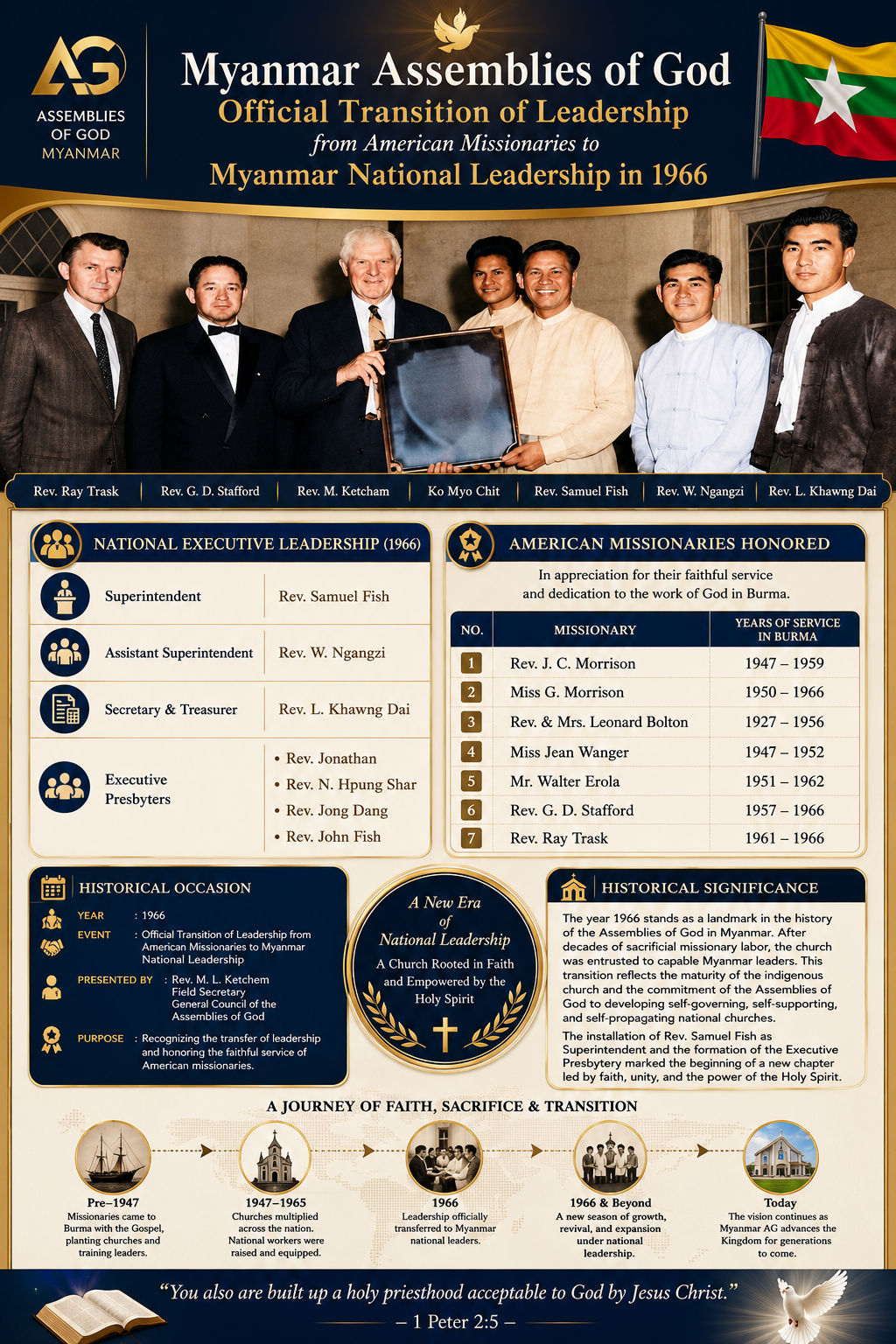
Then came separation. After the military coup of 1962, Myanmar grew increasingly closed to the outside world. In March 1966 the Socialist government issued its order: every foreign missionary was to leave the country by April 30, 1966. Men and women who had given decades—some their whole lives—to the people they loved were compelled to go home.
It is important to tell this moment truthfully. This was not a ceremonial “passing of the torch” chosen freely by the missionaries; it was a door closed by the hand of the state. And yet—here is the wonder of it—the church did not fall. By 1966 the Assemblies of God in Myanmar had grown to more than 180 churches and some 12,000 believers, led increasingly by its own sons and daughters. Because the missionaries had labored from the first day to raise up a national church rather than a dependent one, the church was ready to stand when they were forced to leave.
In Yangon, a former anti-Pentecostal named Myo Chit—who had himself been baptized in the Holy Spirit during the revival of 1961—succeeded the departing missionaries as pastor of the Yangon Evangel Church in that very month of March 1966. He would go on to serve as General Superintendent of the Assemblies of God of Myanmar. When the crowd thinned to ten or fifteen souls on a Sunday, he kept preaching. God kept providing. The seed had been planted; now it would prove whether it could live in its own soil.
The missionaries left. The gospel did not.
The Seed That Would Not Die
“Unless a grain of wheat falls into the earth and dies, it remains alone; but if it dies, it bears much fruit.”
John 12:24
Jesus’ parable of the seed is the truest lens for what followed. The missionary, like the sower, eventually departs; the seed remains in the ground. And in the decades after 1966, with no foreign missionary permitted to work in the land, the seed bore a harvest greater than anything the founders had seen.
Among the Chin—the Zomi peoples of the western highlands—a renewal broke out that would reshape the spiritual landscape of the nation. On January 27, 1973, a pastor named Hau Lian Kham and a small group in the Tedim Baptist Church began praying for revival. The open-air crusade that followed became a launching pad for a movement that swept through offices, schools, and marketplaces. Being born again became the talk of whole towns. Out of that renewal, the Assemblies of God gained the majority of its membership and grew into the third-largest denomination in the country, reporting more than 84,000 members by the year 2000.
And the church did not merely grow—it built. Evangel Bible College opened in Yangon in 1979. Maranatha Bible College opened at Kale in 1988. Bethel Bible College opened at Tedim in 1991, fittingly known as the “Decade of Harvest Center.” A field director who had watched the Myanmar church for years called it a model of the self-governing, self-supporting, self-propagating ideal—a church that not only survived the loss of its missionaries but flourished, precisely because it had been taught from the beginning to depend on the Holy Spirit rather than on foreign hands.
An Unexpected Chapter: The Harvest Becomes Harvesters
History has now taken a turn that the missionaries of 1966 could never have imagined. Across three great waves of migration since 1989—refugees fleeing persecution and conflict, families seeking safety, students and professionals seeking opportunity—hundreds of thousands of people from Myanmar have made their home in the United States. Today more than 190,000 Burmese live in America, and among them are pastors, evangelists, worship leaders, Bible teachers, and faithful believers.
What makes this remarkable is not migration. It is mission. The very nation that once sent missionaries across the ocean to Myanmar is now home to a growing family of Myanmar Assemblies of God believers carrying that same gospel to their own people—and increasingly to their neighbors of every background. In December 2019, this movement was formally recognized when the Myanmar Assemblies of God Fellowship, USA, was chartered as the twenty-fourth official ethnic and language fellowship of the Assemblies of God USA, serving Burmese congregations spread across the nation.
There is a detail in this story almost too fitting to be coincidence. The founding president of that fellowship, Dr. Chin Khua Khai, is the same scholar whose doctoral work at Fuller Theological Seminary chronicled the renewal movement among the Zomi (Chin) people of Myanmar. The historian who documented how the seed grew in Myanmar’s soil is now among those shepherding its fruit on American soil. And the fellowship’s leadership has reached into the American heartland itself—including a Myanmar congregation pastored in Tulsa, Oklahoma. The one who once received has become the one who is sent.
Those who were discipled have become disciplers. The seed has become a forest.
A Partnership Renewed — and Redefined
Nearly a century ago, American Assemblies of God missionaries crossed the Pacific to preach Christ among the peoples of Myanmar. Today, Myanmar Assemblies of God believers are crossing American neighborhoods, cities, and states to reach fellow Myanmar families—and their American neighbors—with that same gospel. This is not replacement. It is multiplication.
The relationship between these two churches is no longer that of missionary and mission field. It has become family. And it beautifully reflects the vision of the Assemblies of God USA Office of Ethnic Relations: that ethnic ministries are not a sideline to the mission of the Church—they are the mission. The Assemblies of God is today the most ethnically diverse major denomination in the United States, and every immigrant congregation is a mission station reaching people who might otherwise never enter an English-speaking church. Many Myanmar congregations now minister not only to first-generation refugees but to American-born youth, to international students, and to neighbors of every language.
The mission field is no longer only across the ocean. It is next door.
“After this I looked, and behold, a great multitude that no one could number, from every nation, from all tribes and peoples and languages, standing before the throne.”
Revelation 7:9
God Is Still Writing the Story
The founders who labored in the Lisu hills and the Yangon back-streets could not have foreseen this reality. They could not have pictured Myanmar pastors planting churches across America, or Myanmar congregations taking their place within American districts, or a day when the two churches would stand side by side not as giver and receiver but as fellow laborers in Christ. Yet God saw it all. His purposes have always reached beyond one generation, one nation, one culture.
Perhaps the greatest legacy of the early missionaries—both the Baptists who came with Judson and the Pentecostals who followed—is not the churches they built, nor the schools they founded, nor even the many they led to Christ. Their greatest legacy is that they raised up a Spirit-filled national church capable of carrying the gospel to the ends of the earth. Today that church is doing exactly that—and it is doing it on the very soil from which its missionaries were first sent.
Only God writes stories like this. And the most stirring truth of all is that He is not finished writing it yet.
AN INVITATION TO THE HARVEST
The Fields Are White — And the Call Is Yours
“Lift up your eyes, and see that the fields are already white for harvest.”
John 4:35
The story of the Assemblies of God in Myanmar and America is not a museum piece to be admired. It is a summons. The same Lord who sent the Judsons ashore at Rangoon, who called the Morrisons into the mountains, who kept Myo Chit preaching to a handful, and who scattered a persecuted people across the nations for the sake of the gospel—that same Lord is calling His people today.
The Great Commission was never given only to missionaries with passports and support letters. It was given to the whole Church:
“Go therefore and make disciples of all nations, baptizing them in the name of the Father and of the Son and of the Holy Spirit, teaching them to observe all that I have commanded you. And behold, I am with you always, to the end of the age.”
Matthew 28:19–20
And the power to obey it was promised to every believer:
“You will receive power when the Holy Spirit has come upon you, and you will be my witnesses … to the end of the earth.”
Acts 1:8
Wherever this reflection finds you, you have a place in this harvest:
If you are in Myanmar, you stand on ground watered by the blood, tears, and prayers of those who went before you. Carry the gospel to the villages, the cities, and the peoples who still wait to hear it. Disciple the next generation. Guard the deposit of faith and pass it on.
If you are in the diaspora—in America, in Malaysia, in India, in Australia, in any land—you were not scattered by accident. Like the believers of the early Church who were dispersed and “went about preaching the word,” you have been planted where you are for a purpose. Reach your own people. Reach your neighbors. Build the church in your new home, and remember the church in your homeland.
And wherever you are, you can give, you can pray, you can send, and you can go. The harvest is plentiful and the laborers are few—so pray the Lord of the harvest to send out laborers, and be willing to be the answer to your own prayer.
The missionaries who first came to Myanmar rested everything on the command and the promise of God. Two centuries later, that promise is still bright. The seed still lives. The harvest is still coming in. May we take up the torch that has been passed to us—across oceans, across generations, and across the whole family of God—until every nation, tribe, people, and language stands before the throne.
“And I am sure of this, that he who began a good work in you will bring it to completion at the day of Jesus Christ.”
Philippians 1:6
Scriptures for Reflection and Preaching
Matthew 28:19–20 — The Great Commission
Acts 1:8 — Empowered by the Holy Spirit to witness to the ends of the earth
John 12:24 — The seed that must fall and die to bear much fruit
John 4:35 — Lift up your eyes—the fields are white for harvest
1 Corinthians 3:6–9 — One plants, another waters, but God gives the growth
2 Timothy 2:2 — Entrusting the faith to reliable people who will teach others
Isaiah 49:6 — A light for the nations, that salvation may reach the ends of the earth
Psalm 126:5–6 — Those who sow in tears shall reap with songs of joy
Revelation 7:9 — Every nation, tribe, people, and language before the throne
Philippians 1:6 — He who began a good work will bring it to completion
A Note on Sources
This reflection draws on the documented history of Christian mission in Myanmar, including the ministry of Adoniram and Ann Judson (arrived Rangoon, 1813); the origins of the Assemblies of God of Myanmar (established 1931, first churches 1933); the government-ordered departure of all foreign missionaries in 1966; and the Chin renewal movement beginning at Tedim in 1973. Primary and scholarly sources include Chin Khua Khai, “Pentecostalism in Myanmar” (Cyberjournal for Pentecostal-Charismatic Research) and Dynamics of Renewal: A Historical Movement Among the Zomi (Chin) in Myanmar (Fuller Theological Seminary); Glenn D. Stafford, “A Brief History of the Assemblies of God of Burma”; historical issues of The Pentecostal Evangel; and reporting from Assemblies of God USA News and the Office of Ethnic Relations on the formation of the Myanmar AG Fellowship, USA (2019).
Scripture quotations are drawn from standard English translations and may be aligned with the preferred Bible edition of the publishing body prior to release.
Published by the Global Myanmar Assemblies of God (GMAG)
Soli Deo Gloria — To God alone be the glory