
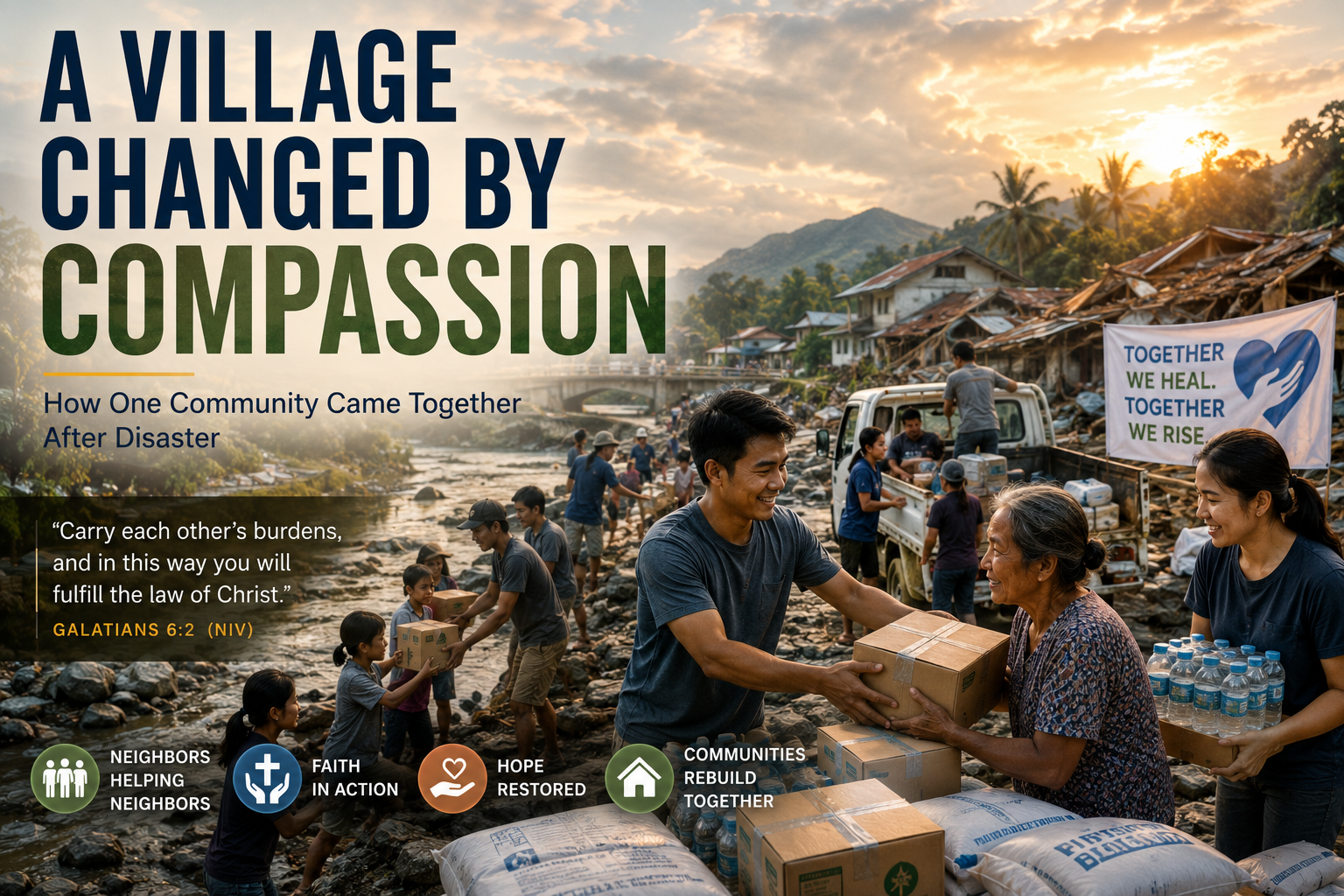
When disaster strikes, headlines often focus on destruction. Yet behind every crisis are stories of courage, generosity, and ordinary people who choose compassion over fear.
Natural disasters leave visible scars on buildings, roads, and landscapes. Less visible are the emotional wounds carried by families who have lost homes, livelihoods, or loved ones. While emergency responders, humanitarian agencies, and governments play essential roles in disaster recovery, another force often emerges quietly in the background: local communities.
History repeatedly demonstrates that communities recover not only because of outside assistance but because neighbors choose to help neighbors.
Compassion becomes the first step toward rebuilding hope.
The Morning Everything Changed
The rain had fallen steadily through the night.
At first, residents believed it would pass as so many storms had before. But by dawn, rivers had overflowed, roads had disappeared beneath muddy water, and families found themselves scrambling to protect what little they could carry.
Electricity failed.
Communication became difficult.
Schools closed.
Entire neighborhoods were isolated.
Parents searched for missing relatives.
Farmers watched fields disappear beneath floodwaters.
Children clung to their families as uncertainty filled the air.
For many, it felt like life had changed overnight.
The First Responders Were Neighbors
Long before outside assistance arrived, local residents began helping one another.
Young men used small boats to rescue elderly neighbors trapped inside flooded homes.
Women prepared meals for displaced families using whatever food remained available.
Teachers opened classrooms as temporary shelters.
Churches, monasteries, and community centers welcomed those who had nowhere else to go.
Local medical workers organized volunteer clinics.
No one waited for permission.
People simply responded.
Disasters often reveal both human vulnerability and human resilience.
Compassion Has No Boundaries
One of the remarkable characteristics of humanitarian response is that compassion frequently crosses social, ethnic, religious, and political boundaries.
During emergencies, communities often discover common humanity more powerful than long-standing differences.
Volunteers seldom ask about ethnicity before delivering food.
Doctors do not inquire about political opinions before treating patients.
Neighbors rarely ask about religious affiliation before helping someone escape rising floodwaters.
In moments of crisis, people often remember what truly matters.
Life.
Dignity.
Hope.
Community.
Faith Expressed Through Action
Throughout history, churches have played an important role in responding to humanitarian crises.
Christian compassion is rooted in the teachings of Jesus, who consistently demonstrated concern for the poor, the sick, the hungry, and the marginalized.
The Gospel records Jesus feeding hungry crowds, healing the sick, comforting the grieving, and calling His followers to love their neighbors as themselves.
For many Christian volunteers, disaster response is not merely humanitarian work.
It is an expression of faith.
As the Epistle of James reminds believers:
“Faith by itself, if it is not accompanied by action, is dead.”
(James 2:17, NIV)
Acts of service become visible demonstrations of invisible faith.
The Power of Small Acts
Not every contribution makes international headlines.
Sometimes rebuilding begins with simple acts.
A blanket.
A warm meal.
A phone charger.
Clean drinking water.
School supplies for children.
A listening ear.
A shared prayer.
A hug offered to someone overwhelmed by grief.
These gestures may seem small individually, but together they restore hope.
Communities are rebuilt one relationship at a time.
Volunteers Who Inspire Others
Behind every successful relief effort are volunteers whose names may never appear in newspapers.
Teachers who spend weekends distributing supplies.
Students cleaning damaged schools.
Healthcare workers providing free medical care.
Drivers transporting relief materials across difficult roads.
Local pastors organizing food distribution.
Community leaders coordinating recovery efforts.
Their service reminds us that leadership is often measured not by titles but by willingness to serve others.
Recovery Takes Time
Although emergency assistance is essential, recovery continues long after television cameras leave.
Families rebuild homes.
Children return to school.
Farmers replant crops.
Small businesses reopen.
Communities repair roads, bridges, and water systems.
Emotional healing also requires time.
Trauma cannot always be measured in statistics.
Grief cannot always be solved through financial assistance.
Long-term recovery depends upon sustained community support.
Hope grows gradually.
Lessons for Every Community
Disasters teach valuable lessons that extend beyond emergency management.
Prepared communities recover more quickly.
Strong relationships matter.
Local leadership matters.
Preparedness matters.
Education matters.
Most importantly, compassion matters.
Communities that invest in trust before disasters often demonstrate greater resilience afterward.
Relationships become infrastructure.
Kindness becomes strength.
Hope becomes contagious.
Looking Beyond the Headlines
News organizations naturally report dramatic events.
Collapsed bridges.
Flooded streets.
Destroyed homes.
These stories deserve attention.
Yet equally important are the stories of people who quietly choose courage over despair.
A teenager helping an elderly neighbor.
A nurse working extra hours without complaint.
Families sharing limited food with strangers.
Volunteers traveling long distances simply to help.
These stories remind us that humanity’s greatest strength often appears during its most difficult moments.
Hope That Endures
Every disaster eventually passes.
Recovery begins.
Communities adapt.
Children laugh again.
Schools reopen.
Markets become busy.
Fields grow green once more.
While physical rebuilding is essential, the restoration of hope may be the greatest achievement of all.
Hope reminds communities that tomorrow can be better than today.
Compassion makes that hope visible.
Conclusion
Disasters reveal much about human society. They expose weaknesses. They test resilience. They challenge leadership. But they also reveal extraordinary generosity. The story of recovery is rarely written by governments alone. It is written by neighbors carrying one another through difficult days. By volunteers choosing service over comfort. By communities refusing to surrender to despair. At Living Water Media, we believe these stories deserve to be told. Not simply because they are inspiring. But because they remind us of a timeless truth: Compassion has the power to rebuild what disaster cannot destroy.
Key Takeaways
- Local communities are often the first and most effective responders during disasters.
- Compassion transcends religious, ethnic, and political differences.
- Christian service reflects faith expressed through practical action.
- Recovery involves emotional, social, and spiritual restoration as well as physical rebuilding.
- Small acts of kindness often have lasting impact.
Scripture References
- Matthew 25:35–40
- Luke 10:25–37
- James 2:14–17
- Galatians 6:2
- Romans 12:15
- 1 John 3:17–18
References
International Federation of Red Cross and Red Crescent Societies – World Disasters Report.
United Nations Office for Disaster Risk Reduction (UNDRR).
World Health Organization – Health Emergency and Disaster Risk Management.
The Holy Bible (NIV).
The Sphere Handbook: Humanitarian Charter and Minimum Standards in Humanitarian Response.