
By the Living Water Media Editorial Board
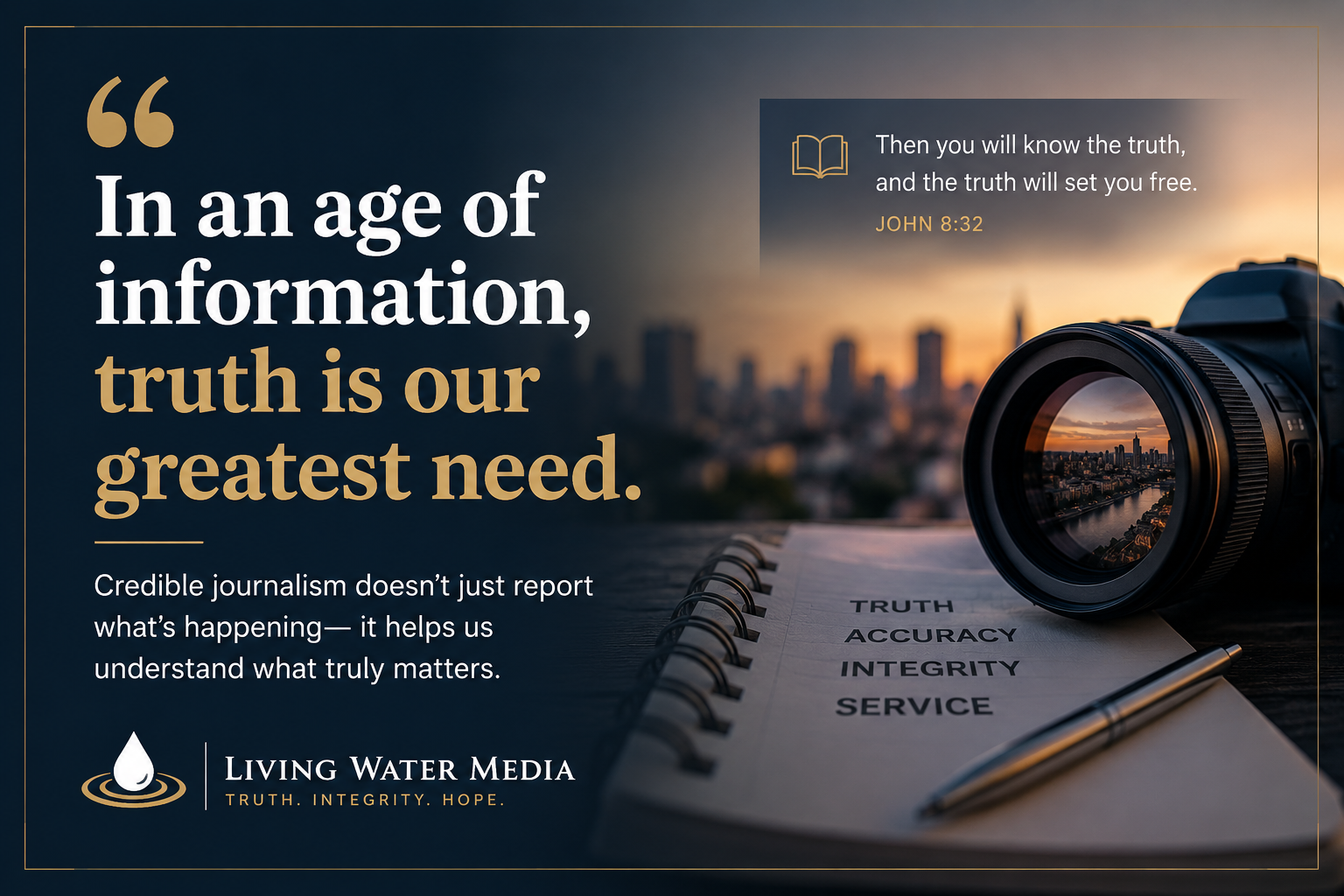
In a world overflowing with information, truth has become one of our most valuable resources.
Never before have so many people had access to so much information. News travels across continents in seconds. A photograph taken in one corner of the world can reach millions of screens within minutes. Social media platforms have given ordinary citizens the ability to report events, share opinions, and influence public conversations in ways that were unimaginable only a generation ago.
Yet this unprecedented access to information has created an equally unprecedented challenge: distinguishing truth from falsehood.
Rumors often travel faster than verified facts. Emotional headlines compete for attention. Artificial intelligence can generate convincing images, videos, and articles within moments. In such an environment, the responsibility of journalism has become more—not less—important.
Living Water Media was founded with this reality in mind.
We believe journalism is more than publishing headlines. It is a public trust.
Journalism as a Public Service
The primary responsibility of journalism has never been simply to report what people are saying.
Its responsibility is to discover what is true.
Professional journalism exists to verify information before publication, provide context rather than confusion, distinguish facts from opinion, and hold institutions accountable through careful reporting. Ethical journalism is guided by enduring principles such as accuracy, fairness, independence, transparency, and accountability.
Good journalism asks difficult questions.
It verifies sources.
It corrects mistakes.
It resists sensationalism.
It serves the public—not ideology.
These principles are especially important in societies experiencing rapid political, technological, economic, and cultural change.
Living in the Information Age
The digital revolution has transformed nearly every aspect of communication.
Today, billions of people receive news not from newspapers or television broadcasts, but from smartphones and social media feeds.
This democratization of publishing has many benefits.
More voices can be heard.
Communities can document local events.
Marginalized groups can tell their own stories.
Important events can be reported immediately.
However, the same technology also enables misinformation to spread rapidly.
False information can circulate long before professional journalists have the opportunity to verify the facts.
Images can be taken out of context.
Videos can be edited deceptively.
Artificial intelligence can generate convincing—but entirely fabricated—content.
In this environment, readers must become more discerning, and news organizations must become more transparent.
Why Trust Matters
Every news organization ultimately depends upon one thing:
Trust.
Without trust, even accurate reporting loses its influence.
Trust is not built through slogans.
It is earned through consistent practice.
Readers should be able to expect that every article has been researched carefully, every quotation verified whenever possible, corrections issued transparently, and opinions clearly distinguished from factual reporting.
Trust grows slowly.
It can disappear quickly.
That is why ethical standards remain essential even as technology changes.
Reuters, one of the world’s leading international news organizations, emphasizes accuracy, balance, transparent corrections, and independence as core principles of its journalism. Likewise, the Society of Professional Journalists encourages journalists to seek truth, minimize harm, act independently, and remain accountable to the public.
Facts, Analysis, and Opinion
One of the greatest sources of confusion in modern media is the failure to distinguish different kinds of content.
At Living Water Media, we believe readers deserve clarity.
Our editorial approach separates content into distinct categories:
News
Objective reporting based on verified facts.
Analysis
Context that helps readers understand why events matter.
Perspectives
Thoughtful commentary and informed opinion clearly identified as such.
Faith
Biblical reflection, theology, and Christian life.
Each serves a different purpose.
Each requires a different style of writing.
Confusing them weakens public understanding.
Separating them strengthens credibility.
A Faith-Informed Approach to Journalism
Living Water Media is rooted in Christian values, but our commitment to truth extends to every subject we cover.
Our faith informs our ethics rather than limiting our reporting.
We believe every person possesses inherent dignity.
We believe justice matters.
We believe compassion matters.
We believe truth matters.
These convictions shape the way we report stories—not by distorting facts to fit predetermined conclusions, but by approaching every story with integrity, humility, fairness, and respect.
Readers from every background are welcome.
Our commitment is not to ideological persuasion but to truthful communication.
Listening Before Speaking
One of the greatest challenges in modern society is that many conversations have become competitions rather than opportunities for understanding.
Responsible journalism begins with listening.
Listening to eyewitnesses.
Listening to experts.
Listening to communities.
Listening to those whose experiences differ from our own.
Only then can a story be reported fairly.
This requires patience.
It requires humility.
It requires the willingness to revise our understanding when new evidence emerges.
These qualities are not signs of weakness.
They are signs of intellectual honesty.
Serving Myanmar and Beyond
Living Water Media exists to serve readers in Myanmar, the global Myanmar diaspora, and the wider international community.
We recognize that our audiences come from different cultures, languages, traditions, and experiences.
Some readers approach our work from a Christian worldview.
Others may not.
We welcome thoughtful dialogue with all.
Our goal is not simply to inform but to encourage careful thinking, respectful conversation, and responsible citizenship.
In an increasingly divided world, journalism can still help people understand one another.
Our Commitment
As Living Water Media grows, we commit ourselves to several enduring principles:
- We will pursue truth over popularity.
- We will value accuracy over speed.
- We will distinguish reporting from opinion.
- We will acknowledge and correct errors transparently.
- We will treat every person with dignity and respect.
- We will report with courage, humility, and integrity.
These commitments are not merely editorial policies.
They are promises to our readers.
Looking Ahead
Technology will continue to change.
Artificial intelligence will become more powerful.
Media platforms will evolve.
Public conversations will shift.
Yet one thing will remain constant:
People will continue to need trustworthy information.
Truth will never become obsolete.
Hope will never lose its relevance.
Integrity will never go out of style.
At Living Water Media, we believe journalism at its best helps people understand the world more clearly, think more wisely, and live more responsibly.
That is the kind of journalism we aspire to practice.
Because truth, when communicated with integrity and compassion, has the power to give life.
Editor’s Note
This editorial introduces the values that shape Living Water Media. While our publication is informed by Christian principles, our reporting is committed to professional journalistic standards, factual accuracy, editorial independence, and respectful engagement with readers from every background.
References
Reuters. “Standards & Values.” Reuters. Accessed June 30, 2026. Reuters Standards & Values.
Society of Professional Journalists. “SPJ Code of Ethics.” Accessed June 30, 2026. SPJ Code of Ethics.
EBSCO Research Starters. “Journalism Ethics and Standards.” Accessed June 30, 2026. Journalism Ethics and Standards.